Grind size determines how much surface area of the coffee is exposed to water at once, which in turn determines how fast extraction happens. Match the grind to the brewing method's contact time, and the rest of the recipe becomes much easier to get right.
Why grind size matters more than almost anything else
Every brewing method gives the water a certain amount of time in contact with the coffee. A method with a short contact time, like espresso, needs a fine grind so that enough surface area is exposed for extraction to happen quickly. A method with a long contact time, like cold brew, needs a coarse grind, or the result would be extracted well past the point of tasting pleasant.
Grind that is mismatched to contact time is the most common reason a recipe that works for someone else fails at home, even when the ratio and technique are copied exactly.
A grind size chart by brewing method
| Method | Grind size | Texture comparison |
|---|---|---|
| Cold brew | Extra coarse | Similar to breadcrumbs |
| French press | Coarse | Similar to coarse sea salt |
| Pour-over (V60, Chemex) | Medium to medium-fine | Similar to sand |
| Drip machine | Medium | Similar to table salt |
| AeroPress | Medium-fine to fine | Between sand and table salt |
| Espresso | Fine | Similar to fine table salt or flour |
These ranges are starting points. The exact right grind for your setup depends on your specific grinder, your water, and your taste, so expect to adjust in small steps from here rather than treating the chart as a fixed answer.
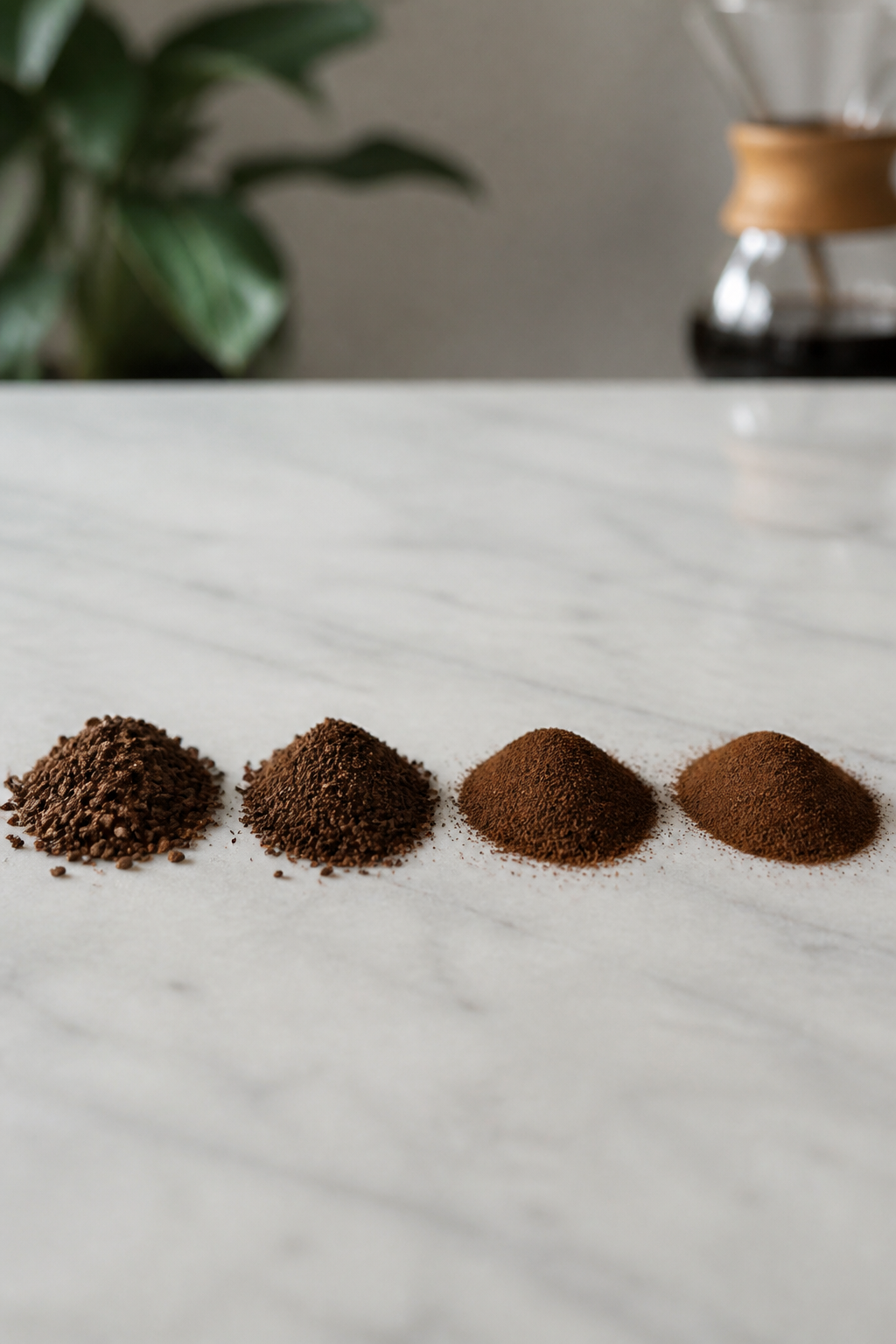
A grind chart tells you where to start. Your own cup, tasted and adjusted one step at a time, is what tells you where to stop.
Reading note
Burr grinders vs blade grinders
A burr grinder crushes beans between two abrasive surfaces set at a fixed distance, producing particles of a much more consistent size. A blade grinder chops beans with a spinning propeller-like blade, which produces a mix of large chunks and fine dust in the same batch, regardless of how long you run it.
That inconsistency matters because a grind full of both large and fine particles extracts unevenly: the fine dust over-extracts and turns bitter while the large chunks under-extract and stay sour, often at the same time in the same cup. This is the single most common reason a burr grinder is recommended as the first upgrade for anyone serious about brewing better coffee.
Dialing in your own grinder
Every grinder has its own scale, and settings do not translate directly between models. Start near the middle of the range suggested for your method, brew a cup, and adjust one step at a time: finer if the brew tastes weak or finishes too quickly, coarser if it tastes bitter or takes far longer than expected to drain.
Where to go next
Grind size and ratio work together, not separately. Once your grind is in a reasonable range, the water and ratios section covers how to fine-tune strength.